Saturday, September 3, 2011

50+ year art project

Open Culture is a great compendium of free educational/culture links.
I spent a lot of time (too much?) on it tonight. Here's two that I liked a lot.
Way back in 1963, Jerry Gretzinger began making a map of his imaginary world.
and
Terry Gilliam's intro to animation.

Thursday, August 25, 2011

the other constellation


August 13, 2011 – This was the forecasted day when the 2011 Perseid Meteor shower would reach its prolific peak, and it brought me to the search for the best location to watch this in my New Jersey neighborhood.  Atop a hill I stayed vigil in the pre-dawn to sunrise hours for this, but the experience was less than stellar because of light pollution.

But magically, by dawn, this experience of lack was compensated by my visualizing of similarly impressive phenomenon: not from above, but from below; not stellar, but earthly; not large and expansive, but small and measured.  The dawn light illuminated to me that the meadow I was standing vigil on was covered with sheets and sheets of funnel spider webs glittering with thousands of dew orbs.  The experience of space that I lacked earlier had been replaced by a dewy and spiderry one by my feet.  Had the conditions been favorable I would have experienced 2 different notions of constellation within a matter of 3 hours. 

Constellations are these stellar patterns that have been watched, observed, read, measured and contemplated since the dawn of humankind for various purposes.  During antiquity they helped in navigation and agriculture before being replaced by later technological devices.  At the same time –and even in the present- their distance, mapping and connections are the material of myths, legends and poetry.

But because constellations inhabit this space outside the confines of our planet, there’s always been this otherness to them.  It has been Other from the time that humans walked the earth. It is still Other today - a surprising notion since there’s been reasonably sophisticated accomplishments in the level of spacecraft and space studies within a teeny tiny fraction of cultural time. 

My guess for its otherness is we -as conscious beings bounded by the imperatives of our dimensionally solid and stable bodies -there is something in us that finds more security in the tactile attainability of things.  Despite the vastly proven equal power of other sensate presences (sight, sound, smell and taste of a thing), touch often gives a final say in the confirmation of the stability and believability of things.  Hence we have this category that covers these things that possess otherness, the enigmatic, mysterious, and unknown – a category that we associate with what lacks a physically defined, attainable and measurable body.  Space belongs to this category.  And so do belief, feelings, thoughts, memory. 

With those last 4 things just mentioned, this category is therefore powerful.  But its being a power lacking tangible body makes it also threatening.  And so our history will show us that a great bulk of it contains chronicles of our efforts to assign some tangible or measurable form to these enigmatic things –efforts to eliminate our fear and harness their power. And so structures have been built, sculpted, painted, written, drawn, drafted to map, organize, and put them all in place with us. 

But that putting into measurable form is merely one strategy of dealing with the category of the enigmatic.  Surely there are several, but one I find more compelling, compassionate, and less driven by a fear factor is analogy.

Analogy could also be employed in form building, but intrinsically it is driven more by our human desire in making connections.  In her impressive book Visual Analogy, Barbara Maria Stafford wrote, “Perceiving a lack of something- whether physical emotional, spiritual, or intellectual- inspires us to search an approximating resemblance to fill its place.” (p2)

With analogical thinking, there’s no imperative to make structures to put the formless enigmatic in place; instead, through some connection or approximation, we can link it to something that already exists, something we know and possess, so that the link between them will grant us this oscillating knowledge and understanding of their similarities and differences without subjugating their distinctive qualities.  With analogy, the enigmatic keeps its indecipherability, but it is illuminated by our lived experience and knowledge of what we already have.  With analogy, the impenetrability of the enigmatic is replaced by coherence brought by its resemblance to a thing we possess, or a certain quality of that thing. 

With analogical thinking the constellation above me on those pre-dawn hours of August 13 is no longer as remote and unattainable.  The constellation on the spider web on the meadow I’m on gives me a visual likeness that is enough to close the distance between myself, the constellation-like web below, and web-like constellation above.

For more on analogy, check out Stafford’s book-it’s awesome!

Sunday, August 21, 2011

hands

My parents have a photograph of my grandfather taken before I was born. In it, he is gesturing, his fingers seem exaggeratedly long and thin. Though not quite as extreme, my sisters and I all inherited his fingers. My work would defiantly be different if my fingers were thicker. Larger fingers and I'd be a different person entirely.

Saturday, August 20, 2011

NEA interview with Alumni Caroline Mak

Caroline Mak, who is having an upcoming exhibition in the Project Room on September 10, was interviewed for the NEA blog about the importance of residencies. She participated in overlapping residencies at Elsewhere and Gallery Aferro.


Sunday, August 14, 2011

HAND POST

Here is my Hands post. It is my favorite youtube video!

Tuesday, August 9, 2011

translator traitor


I'm interested in translation, both of the nuanced and the totally provisional, not-really-right variety. I noticed when we were building the first Aferro that the isolation from outside of our small building community led to slang that then turned into a smallish working vocabulary that was odd enough to confuse others.

As a nonsigner, I can't tell what they are really saying in this video, or comment the quality of the language. Wonder if there is any Lorca in ASL. Any signers out there? How are they doing?

and


interuption from HANDS week

Greetings everyone! These are the countries visiting this blog most:

United States
1,720
United Kingdom
110
Russia
46
Germany
44
Ukraine
32
India
25
South Korea
20
Canada
19
Poland
19
Uganda
19


Friday, August 5, 2011

hands with words:


When I see tattooed hands, I sometimes think about the inscribed hands Robert Mitchum's character in Charles Laughton's 1955 film, "Night of the Hunter" (top).  It was cool how Spike Lee echoed that with Radio Raheem in "Do the Right Thing". Mitchum has the words Love and Hate tatooed on his knuckles, while Raheem wears the same two words as gold mega-rings.  I don't think the monologues they deliver, describing the epic battle of right and left, love and hate, good and evil (directed at the fourth wall) are word-for-word identical, but they are pretty close...

Wednesday, August 3, 2011

tattooed hands


I'm interested in people who get tattoos on their hands. The hands are a "total commitment" tattoo (and your face, obviously) in that you can't hide them. I love seeing what people get on their fingers and the variations on four letter, related, meaningful words.

Tuesday, August 2, 2011

Friday, July 15, 2011

the pencil of nature:

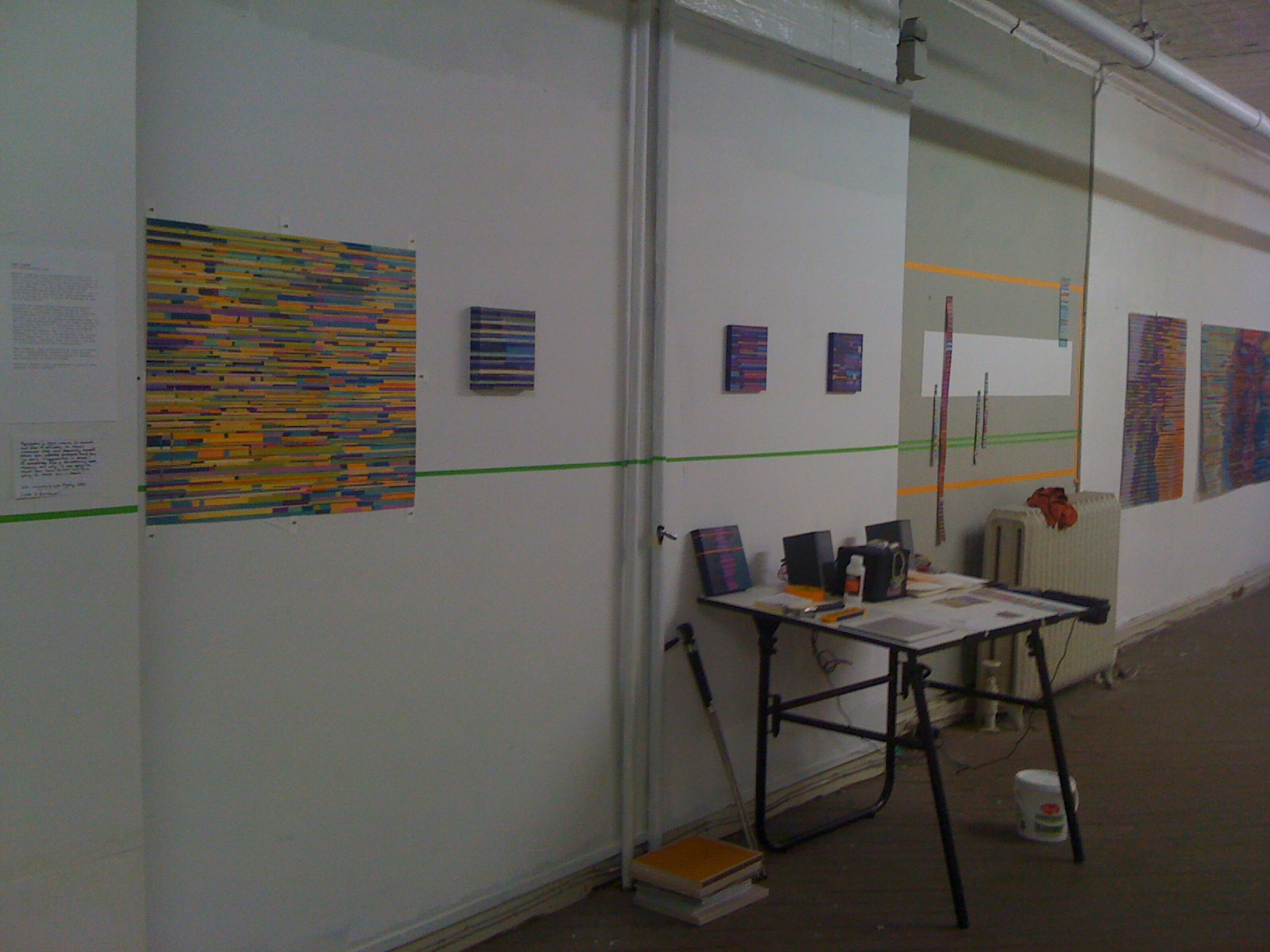
I've been steadily photographing my studio here since I moved into Aferro in February.  I use the camera for a number of reasons.  As I work, I find that I'm constantly inventing (reinventing, I'm sure) ways to do things.  Sometimes in the middle of it I notice that I'm interested, in sort of a detached way, in how a process looks.  I try to record those views.  I also want to remember specific things that I did, and especially to recall ideas that emerged on the way to something else.  I take a lot of notes and make lots of little sketches, but photography is another way to keep an idea around.


Here are a few shots from the past months:


just moving in...
Ken Weathersby
click image to enlarge


an array of very small works
Ken Weathersby
click image to enlarge


painting process shot
Ken Weathersby
click image to enlarge


idea/process
Ken Weathersby
click image to enlarge


painting process shot
Ken Weathersby
click image to enlarge


painting process shot
Ken Weathersby
click image to enlarge


painting wall
Ken Weathersby
click image to enlarge


A Farm Bureau Meeting on the P... Digital ID: 92258. New York Public Library

and

Sunday, July 3, 2011

AiOP Ritual 2011

Fellow Aferro Resident Patricia & I are going to be part of Art in Odd Places Festival this year. We didn't know until we ran into each other at their meeting. Small World!

Wednesday, June 29, 2011

Two pantomime children

A few months ago, I saw To What Earth Does This Sweet Cold Belong? at the Power Plant in Toronto. http://www.thepowerplant.org/Exhibitions/2011/2011_Spring/To-What-Earth-Does-This-Sweet-Cold-Belong-.aspx I picked up a copy of Christian Bök's poem "Midwinter Glaciaria" which was available with the show. It's a long and dense poem filled with dreamlike imagery and spiderweb tangents. I cut the poem into stanzas and have been letting them float around on my desk. Even though I've read it all many times, each reading brings new details and another trip down the rabbit hole.

Deciduous trees, black without foliation, etch neural pathways on a dream of glass photographs. Nitrates of silver electroplate mirrors. Peroxide evaporates from smashed ampoules of ice. Timberwolves circle the clearing. Two pantomime children perform there the drama of winter. The girl in lace pouring pitchers of ice water over the kneeling form of her nude sister, whose shivers subside into an icy chrysalis. The audience unseen as it watches liquid nitrogen spill over the edge of the stage.

Sunday, June 26, 2011

Blue

Can’t stop applying the color blue to my work. “Long associated with the serenity of a clear, cloudless blue sky reflected over a calm sea, the light, mid and deep blues bring a feeling of respite and introspection – a quiet, cool permanence. The human mind embraces the concept of blue as tranquil and constant and translates it into a symbolic image of dependability and loyalty.”

Thursday, June 23, 2011

Don Edler: Performance Artist, Sunday, June 26, Chelsea


am-beingandevent3.1.jpg


For Immediate Release - June 22, 2011

Artists Meeting Presents:

Being and Event - A Free Night of Performance - Live at Postmasters Gallery
459 West 19th Street, New York NY
Sunday June 26th - starting at 8pm.


Artists Meeting and Postmasters Gallery invite you to attend the collectives latest multimedia showcase investigating the borders of performance art. Being and Event refers to the book of the same title by philosopher Alain Badiou. With special guest MC Al Lupiani, Artists Meeting loosely addresses his theories in two types of performances. The overarching questions are, what constitutes being and what constitutes an event in the 21st Century.

On the being side are performances by Maria Joao Salema, Don Edler, Paulina V. Ahlstrom and Abigail Weg. On the event side are performances by Sofy Yuditskaya, Olga Lysenko & Fernando Sanabria, Lee Wells, Douglas Kelley, GH Hovagimyan, Raphaele Shirley, the Nsumi Collective with Dungeon Master and surprise special guests.

This will be Artists Meeting's fourth multi-media performance event at Postmasters and follow up to the 1st YouTube Slam, Triptych Party, Weirder The Better, and A-List Cannibal Cage Match.

Being and Event – Program


Being - 8-9pm

Don Edler - Drinking about the Universe
Inviting the audience for free beer at his portable minibar and encouraged to talk about their views of the universe.

Maria Joao Salema - The Moving Still Life
A projected video of an endlessly collapsing still life

Paulina V. Ahlstrom - This Moment
Upon entering the audience will be givin slips of paper with the words “this moment” written on them and record participants thoughts throughout the evening.


Abigail Weg - Interactive Face Painting
will be conducting an interactive installation using projected imagery to paint portraits of the audience.


Event – 9 -11pm

Sofy Yudiskayana - Differences in Duration of the Eternal Return
Objects are captured and reprojected onto their original site of occurrence quantized sound and objects in interactive performance.

Olga Lysenko & Fernando Sanabria - The Wino
Compositions performed on a full-scale wine-bottle-glass piano in an attempt to create a moment of magic.

Lee Wells - Artistic Survival Techniques for the End of the World and Beyond
A multi-media event within an event, briefly touching on a wide range of new topics with special guests including:

• Douglas Kelley - Revenge of Art History
A discussion on Artists Survival Technigues that reference to Francis Fukuyama’s, The End of History and the Last Man.

• Victor Sheely - Myth Thunder Standings

On hind legs, King Coyote Butterfly floats a stinging bee blessing ceremony of the evening's proceedings.

• David Henry Brown Jr -
The Thinker
Will present a performance about survival in a future where the state and private thought are ever merging.


GH Hovagimyan - Boxing Rants

An interactive shadow-boxing rant performance using a hacked Kinect Camera.

Raphaele Shirley - Red line, cigarette, running man, spinning circle
A minimal performance act and multimedia visual landscape that morphs into a full scale kinetic sculpture in the spirit of Nam June Paik’s fluxus performances. 


NSUMI Collective with Dungeon Master - The First International Speed Metal Drumming and Arts Education Symposium

Ashort discussion with five one-minute speed metal drum performances, concluding with a five-minute discussion about feelings experienced by drummers as they perform.

For more detailed information please see www.artistsmeeting.org

Note:
For more information contact: artistsmeeting@nujus.net or Postmasters Gallery
459 West 19th Street, New York NY 10011, 1-212-727-3323

Postmasters Gallery opened in East Village in December 1984, moved to Soho in 1989 and in September 1998 the gallery relocated again to a large ground floor space in Chelsea. During its 25 years Postmasters has shown young and established artists of all media, actively seeking new forms of creative expression and show them in a context of painting, sculpture and photography. The artworks are generally content oriented, conceptually based, and - most importantly - reflective of our time.
www.postmastersart.com

Tuesday, June 21, 2011

A former studio resident is showing a new installation in a group show "Festival" at Kips Gallery.

If you have a time check out the opening reception this coming Thursday.
Opening Reception is June 23, 2011 6pm-8pm

Show is up until June 30th.
Kips gallery
511 W. 25th Street. 2nd fl. (Btw 10th Ave and 11th Ave)
New York, NY

Sunday, June 19, 2011

The Sticky Parts


If you are in Seattle area or have any friends out there, I have a show opening this Thursday June 23.
Dahlia Elsayed: The Sticky Parts
June 23-July 21, 2011
Gallery at S. Seattle Community College
6000 16th Ave SW
Seattle WA 98106

Friday, June 3, 2011

What I saw Today in Newark

June 3: A hairpiece in a pothole.

Monday, May 23, 2011

inspirations....Doris Salcedo


The new work, Plegaria Muda, asks us to reflect on the grey zones that always appear in the murky margins of our societies; zones in which the roles of perpetrator and victim tend to merge and where a human life more easily can be degraded ...into nothing. It stems from a three-year-long research of the ghettoes of South East Los Angeles, but it is also a direct answer to repeated atrocities committed by groupings within the Colombian army between the years 2003 and 2009.
more at http://www.artdaily.org/index.asp?int_sec=2&int_new=47584


Thursday, April 28, 2011

Blithe Riley: The Edna Experiments

The Edna Experiments: Blithe Riley

New Media Room and Liminal Space
May 7 - June 3, 2011
Opening Reception May 7, 6-9 PM

The Edna Experiments is a multi-media installation project based on the found diaries of a rural housewife named Edna. The diaries span approximately 15 years—covering the late 1950′s to early 1970′s— and are full of meticulous everyday details but no emotions whatsoever. The books are records of an edited life, where what is preserved is terse, systematic and rooted in domestic and rural labor. Insight is gained only through repetition of action (washing, ironing, mending), as very few entries stand out above the others. In addition, Edna’s writing forces us to interpret and imagine what we assume are the missing details. That act of interpretation is a key point of interest in the project.

The diaries not only represent records of personal discipline (Edna wrote almost every day), they are also archives of banal moments that rarely get memorialized. Edna’s diaries question what constitutes a lived life. They reveal how the things we leave behind frame our lives after we die.

Blithe Riley works in video, performance & installation. Her practice investigates systems that regulate human behavior, including self-induced structures as well as those inflicted from external sources. Riley received a BFA from Alfred School of Art and Design in 1999, and an MFA from Carnegie Mellon University in 2005 where she taught courses in video and performance. In 2009 she was a resident of Skowhegan School of Painting and Sculpture, and an Aferro Studio resident in 2010. Her work has screened nationally & internationally at venues such as the Lower Manhattan Cultural Council, The Kitchen, Roulette, Broadway 1602 Gallery and Monkeytown in New York City, The Warhol Museum in Pittsburgh and The European Media Arts Festival in Germany. She has taught classes at Columbia College Chicago, Parsons, and George Washington University. She lives and works in Brooklyn, NY. Riley also makes site-specific video and performance work with artist Mary Coble. Together they have made work in an abandoned spring house in Maine, and in a soon-to-be demolished housing project in Northeast London. Their collaboration is represented by Conner Contemporary Art in Washington, DC.

Facebook

Gallery Aferro site


Blithe Riley site

Saturday, April 23, 2011

Museum of Contemporary Art Chicago

At the beginning of my artist career, I was doing performance and video art. Since then, I am aware of the public or audience. I found this to be an interesting exhibit and reading : Without You I'm Nothing: Art and Its Audience

Friday, April 22, 2011

Tuesday, April 19, 2011

New Grantee: Gallery Aferro

New Grantee: Gallery Aferro

Shoutout to alumni here! Top image: Ann LePore in her studio during Open Doors 2010.
Bottom image: public interaction with Kate Okeson's exhibition in the Liminal Space.
and thank you very, very much to the Geraldine R. Dodge Foundation for their support of Gallery Aferro.

Saturday, April 16, 2011

A partial list of things in my studio...


lint from Julie and her cat Charlotte


lint from a studio mate


repetition with cotton balls


I'm trying to think of a name for this. Maybe 'Gathering For a New Coat'


a paper house


in my supply box


my notebook


my reading stack


Friday, April 15, 2011

Young Artists from Newark

These young women are part of our new education program, Identity Blueprint. Check it out!

old but good

This has been all over the internet for a while, but as it is dead on, I see no reason not to share it here:

Thursday, April 7, 2011

Thursday, March 24, 2011

back from Berlin


7 woman artists - 12 days - 1 city- 1 history - unforgettable - all under the shadow of magenta - I am dying to do it again - thank you everybody!

Magenta, group exhibition at
Galerie R31 - Berlin

Friday, March 4, 2011


...I think my work really started, when I embrace my own history.
Alexis Rockwell

Thursday, March 3, 2011

Please join us at Valley Arts next Sat! The whole neighborhood context of Ironworks/Valley Arts is really great. They have an urban farm next door.
Blithe Riley

Apocrypha

Kenseth Armstead, Dahlia Elsayed and Blithe Riley
curated by Evonne M. Davis and Emma Wilcox from the Galllery Aferro Studio Residency Program

March 5 - April 15, 2011
Opening Reception March 12, 6-9 PM


Ironworks Gallery
Valley Arts
406 Tompkins St Orange NJ


Gallery Hours: M-Fri 10-5, Sat 9-12

Kenseth Armstead, Dahlia Elsayed and Blithe Riley

are artists whose current projects are rooted in biography and autobiography.


The questions of authorship and authority that arise when artists work with found autobiographical material, or in the realm of “unofficial history,” are complex. Each text-based project has been shaped by the artist’s motivations.

Kenseth Armstead’s “Spook 1781” project began with a full length screenplay and continues to assume new forms, including video, interactive tapings, drawings and murals, all concerning the life and activities of James Armistead Lafayette, an African double agent during the Revolutionary War. Armstead writes “Like many other African Americans living in the shadow of the decline of the slave trade, family history is subject full of mystery.” The web is an easy first step toolbox for the novice historian. Sometimes it leads to interesting fiction and in my case it led me to a Google search on one of the spellings of my family name, Armistead.”

Dahlia Elsayed’s journalistic, text-driven, paintings record the minutia of the artist’s daily life. She writes, “Part data-tracking, part topography, these conceptual maps examine the aesthetic surfaces and ephemeral cultural markers of recent immigrant populations, of which I am a product.” Elsayed originally studied to be a novelist.

Blithe Riley has been creating drawings, videos, and installations based on the diaries, covering roughly 50’s-70’s, of a rural American housewife named Edna. Riley found the diaries in 2009, and “The Edna Experiments” are ongoing. Riley writes, “The diaries interest me not only as a records of personal discipline, but also as records of a life that features the minute details that are rarely memorialized. They ask the question of what constitutes a life, and what we leave behind. What are the tools that we have to understand the lives of the dead when there is nobody to speak on their behalf? “How do we fill in the emotional gaps that exist with what we’re given to reconstruct from?”

Monday, February 28, 2011

Hallucination invitation:

There is currently an excellent show open at Kent Place Gallery.
 
I am gallery director there -- the gallery is on the campus of Kent Place School in Summit, NJ, where I also teach art.

There will be a closing reception for the artist on Friday, March 11 (see below for details). Summit is not too far away (geographically-- i.e., it is in northern New Jersey), and Bruce is an amazing artist.  I hope will see you all there at the reception!


sweet stain, oil, acrylic, pencil & ink on canvas, paper, wood & cashmere 
Bruce Stiglich
click image to enlarge


“Accumulation/Hallucination”


Bruce Stiglich’s “Accumulation/Hallucination”

Kent Place Gallery Monday, February 14 – Friday, March 11
closing reception 6—8 pm on Friday March 11.


Works in the show combine painting, drawing and the gathering of found objects to create complex, beautiful and densely painted collections of surfaces and images.


“Sweet Stain” (above), uses a wide range of means, including oil paint, acrylic, graphite, ink, wood, and, crucially, cashmere. A tiny scrap of stained cashmere formed the starting point of this complex work. Stiglich painted a portrait of the scrap of fabric, enlarged and copied his own painting, represented it again in another way, again and again, and each new view became a part of the whole. The cluster of representations contains mirrorings and repetitions, but also surprises that open up space for the imagination. It is a kaleidoscopic outgrowth of remembering and reflecting. Yet the subject (if that shred of stained fabric is really the subject) remains enigmatic.


Such a ceaseless return to a mute and mysterious object, and the possibly obsessive circling around it with art, brings to mind Citizen Kane’s rosebud, Proust’s madeleine, that little scrap of blue velvet so prized by Frank in David Lynch’s film. The point for me is that Stiglich creates an exciting, almost hallucinatory visual world, and the work resists collapsing into an easy interpretation.

New York Times art critic Ken Johnson has said, “Style in Bruce Stiglich's work is psychological, as the seemingly obsessive repetition of tiny marks that build up into dense vibrating textures suggest the feverishly compulsive activity of an inspired monomaniac. You may be reminded of Jackson Pollock's drip works or folk artists who are driven to decorate their homes with countless polka dots or flattened beer cans.”


Bruce says, “My work is a compiling of personal history. I work in series. These series become installations. They span an extended period of time. It begins with a discovery of found images, objects and doodles that to me seem incomplete. The process of completing the images is self referential in nature.”


Bruce Stiglich’s art work has been seen in numerous exhibitions in recent years in New York City and the New York area, in Pennsylvania, and in Miami, Florida. He currently teaches at Parsons School of Design, and has also taught at Pont-Aven School of Art in France, and at the State University of New York. He has been a curator of several art exhibitions at MyPAC, in Miami, FL.


Kent Place Gallery

42 Norwood Ave.
Summit, NJ 07902
 

Monday, February 21, 2011

I really like this breakdown of a workspace- it articulates reality as I see it-

A place of work: in this sense of the meaning, it is the artist’s identified location of work. It is an address, an office, a workplace. It is an actual and psychological place that compells the artist to go to work. It legitimises the artist’s practice. It locates the artist in a geographic place but also, by extension, in society.

A place to work: this refers to the physical studio, light, heat, equipment and facilities that enable the artist to get immersed in the artistic process and in the making of art products. It is also a place for other work to happen such as research and planning. This definition is about work happening.

A place for work: this definition brings in the other functions of the studio - a place where work is kept; where work is waiting to be finished; where collected references are displayed and stored; a place where work is exhibited.


PS- I am about to create this sort of rubric for my body, as current events unfolding seem to have been predicted many years ago by Margaret Atwood.


Saturday, February 19, 2011

Beginning:

It was great to get started today officially on my February-through-August residency-- at least in the sense of getting keys and finding out which studio will be mine. I was glad to meet Emma and Evonne again, and to be introduced to the other artists.  Actual move in will be soon.

Ken Weathersby, painting / paper collage (acrylic & graphite over printed image of linen, with printed paper inset)
5.5" x 4.25" , 2-11


I've made some very tiny works lately, like the one above, and before yesterday I actually never thought about that being a reaction to the crowdedness of the rather small studio I've been painting in for the last ten years.  

These little pieces might be models or mockups, or they might be works in their own right. 

I am definitely thinking about a containing spatial element and aspects of architectural space in planning my next paintings, pieces I want to make at Aferro.  

So beginning to work in a different and bigger room might have more than simple practical advantages.


--Ken Weathersby


Thursday, February 17, 2011

Grid with gold leaf.

Detail with gold leaf added.


Wednesday, February 2, 2011

Over the last several weeks I’ve had a chance to print out more than 30 images shot on Market Street of the varied and random chewing gum marks found on the sidewalk. It’s been an exciting project to pursue, and one that I'll continue working with once the residency is finished. My current approach has been to crop in closely to each section of concrete and view each as a separate composition.


In the next versions that I’ll pursue, I’ll be utilizing the expansion joints as compositional elements, which will allow me to incorporate vertical, horizontal, and diagonal lines along with the random patterning created by the chewing gum markings.

It has taken quite a bit of experimenting to hone in on the post-processing of the images. Its important to me that there is sufficient contrast between the pavement and marks; I have taken a number of steps with each image to enhance the rich gray and black tones of each individual mark.


Each series of photos is displayed in a grid; while all of these photos document random mark making, I’m interested in the suggestion of order that a grid format provides.

The next step for this series involves adding gold leaf, by hand, to individual marks on each photo. My intentions are to re-examine familiar and overlooked relationships between social interactions and physical spaces. Gold leaf, in this project, functions as a signifier of value—raising questions about what has intrinsic worth and what is discarded, both materially and personally, in contemporary society.

Tuesday, February 1, 2011

Thank you!

I am delighted to become a member of your community! can't wait to start (my residency) and get to meet you all.


here are the images from my recent natural history museum project.

Thursday, January 27, 2011

Northern Soul?

Snowing again.

It used to be, before the internet, that if you had heard a song somewhere, or a friend made you a mix tape with no papers, you might go years without knowing whose song it was. You would memorize the lyrics. I used to tape off the warping records (steam heat in the media room of the Morris County Public Library) and then not write down the names of the tracks. I'm not a musician, (or a hipster.) But I like spaces, corners, spatial relations. I'm a photographer of buildings. One of my major goals is to take a really great photograph of a corner someday. And I often think about the pictures as either poems, or songs.

You can stop gagging now.

I simply mean that what would satisfy, what would count as a good day's work for creative output- I want it to have the qualities that I find in, say, a Kevin Young poem's near rhymes, or the haunting quality of a live recording, by Champion Jack Dupree, of Frankie and Johnny. I didn't know who had sung this version, not for years. I just knew I liked it, how the sounds of a room were in the track, the sound of glasses or bottles, the way someone, probably a woman, yells towards the end. It makes me think of echolation, in water.

The room is in the track.

If you can put aside larger cultural debate on Robert Johnson for a moment, you have to admit that all the craziness with figuring out whether his tracks were sped up is amazing nerdery- they are remaking the room, inhabited by ordinary mortal breath.

I love cheap wordplay and I love covers. Forget Lord of the Rings, give me "Dempsy," which reads to me as a pastiche of Jersey City and the South Bronx, created by Richard Prince. I love the scene where high school kids make their own version of Spoon River Anthology but set in Dempsy, where they live.

Back to Robert Johnson.

E, who had a trust fund and thus was always coming up with criminal schemes (the edge is safer with a cushion) out of warner brothers, used to play a wonderful cover of Come on in my kitchen. He was very shy about playing in front of people, like it was obscene. He stole from us later, but that's another story.

Anyway, R., his friend, would say, "accidents happen", as he skinned rats from the apartment building. He was from the country originally. I have two pelts, the little feet are articulated so well. He would say that, but that was before he fell multiple stories onto his head, went to Bellevue, and now is a different person. When I first met him, we were listening the Ramones, I sometimes think of him when I hear Cretin Hop, though in some ways that isn't funny anymore. But really, that was the song that was playing, I swear. For some reason I always remember what song was playing when I meet people. Cretin Hop makes me think of summer, and Coney Island. Where it isn't snowing, because it's a memory and I can have it any way I want.


Te-na, Te-na-na
Te-na, Na-ne-na
Te-na, Na-na-na
Te-na, Na-na-n'-na


Te-na, Te-na-na
Te-na, Na-ne-na
Te-na, Na-na-na
Te-na, Na-na-n'-na

Tuesday, January 25, 2011

Coming Back to Newark!

What a happy soul you have made me, Aferro comrades! Thank you. I looking forward to coming back to Newark and working hard at Aferro. Emma's idea of artists' books intrigues me greatly. It's snowing up here in Providence. A real winter.

Tuesday, January 18, 2011

Night School / Art School

The unitednationsplaza archive is now online. Missing from the "night school" section, though, is the lecture by Walid Raad, No. 10, which was provocative and poetic. Adjectives, adjectives, I know. But it was. He described a scenario where authorities might instigate the creation of a art spot that would be open irregular hours and appear, in every way, to be avant, underground, etc...

Art School (Propositions for the 21st Century) edited by Steven Henry Madoff looks good.

Monday, January 17, 2011


Thursday, January 13, 2011

also

I have applied to be an ArtReach mentor this year. I will be thrilled to be accepted, while I am of course busy I feel a significant debt to the sundry and various people who have helped me since I was a teenager. It would be great to try to pay some of that back in.

One of the ways in which mentors may work with their students in in studio assistant mode (old school!). In the case of my practice, the most pressing need in my studio is to wash and de-label my pint bottle collection, which must be damn close to 1000. This seems kind of unseemly though. Many art materials are "messy" and might require an apron and gloves, but not all art materials are loaded with specific signifiers, like say, a bottle of cheap fortified wine is. Probably inappropriate. But this is what I need help with. Do not want to be a thoughtless mentor.

Verbiage

My output at the end of the Newark Museum residency was a powerpoint I had created by retyping and collaging (zine copier style) different sentences, paragraphs and text fragments from manufacturer directories of Newark, mostly circa 1850-80, and many eras of histories of Newark, including books for children. Will get into why I work with specific time periods later, not in this post.

Anyway it was supposed to be a short film of sorts, allowing me to emphasize pauses and certain words to make a different, more doubtful and subversive narrative about my old standbys, failure and expectations. I can't say I succeeded. There is plenty of bad text art out there, and as a photographer the tension in working with words (which I love doing) is always there.

How about a palate cleanser?

However, I am bound and determined to try to make an artist book from these 2009 efforts. There is always so much text and reading behind every picture I make, it would be nice to show some of the source material. I've proposed to the Print Center that I work with an old, early survey of Newark, which is a beautiful piece of language. The last time I wrote about working with them, I was promising to grow things. The seeds grew sprouts, but I didn't get them into the ground in time. Going to try again this spring. I know, promises, promises...

Saturday, January 8, 2011

persistence ...

Gallery Aferro, Lane Cooper, "Blindness"
Gallery Aferro, Lane Cooper, Studio View
Charing Cross: Newark - video link

I write you

you smile
you say wise things
and guide the orphans we’ve become

thin dry tendrils become fertile laughter
and rings like bells
now more than dogs
greet us at the door
there is plenty
more than enough

and we are not a burden

(The above is an excerpt from the text for the artist book I’m working on.)

The past few months have been amazingly productive for me. The atmosphere of working at Aferro and living in city have created for me an incubator of thought that has been profound. I’ve had the opportunity to meet and work with some of the most committed and thoughtful people I’ve ever known, really an inspiration. Seeing the commitment of Evonne and Emma … and then making new contacts through friends and people now becoming friends … all of this has afforded me remarkable opportunities.

Working with Margret Hjaltested, Malina Rauschenfels and Melissa Bybee has opened up tremendous possibilities in the sound for my pieces. All accomplished musicians, they’re incredibly generous in their time and energies. These connections would not have been possible had Aferro not given me the opportunity to participate in the residency.

My project, “What Persists”, has unfolded in ways that have informed all aspects of my work. The content and visual connections between sound, video, painting and writing have revealed themselves in a way that now I feel my work makes sense as a body.

All of my work productions stem from the understanding of reading and writing. Everything is a text of fragmentary information. We read and fill in the gaps, imaging the bigger picture, giving ourselves a means of understanding. It is why two people to do not, cannot, see the same painting, cannot read the same book, or even hear the same sound. We cannot meet the same person. Each approach fills the gaps differently. This is the home of wonder.

What persists? A infrastructure of meaning … a screen onto which we project … experience … and wonder.

The work continues and I can’t wait to see how it continues to develop from here.

--
so far - production – Extending from my so far while here I’ve produced a number of paintings and completed four videos with sound pieces. Two of the sound pieces were done for me by Malina Rauschefels. I’ve also made good progress on the text for an artist book, although this part of my project is perhaps not as far along as I’d like. In the end I foresee an installation centered around one or two of the videos.